You buy a bottle of "Extra Virgin" olive oil, believing you are making a healthy choice. You imagine it is packed with antioxidants, ready to protect your heart and fight inflammation. But here is the uncomfortable truth: by the time you drizzle that oil onto your salad, many of those health benefits may have already vanished.
The olive oil industry has a secret problem. It isn't just about fraud or fake oil; it is about fragility. The very compounds that make olive oil a superfood—polyphenols—are incredibly unstable. They are fighting a losing battle against time, light, heat, and oxygen from the moment the olive is picked.
For consumers seeking health benefits, this is a critical issue. You might be paying a premium for polyphenol degradation rather than polyphenol potency. Understanding why most olive oils fail to deliver on their promise requires looking behind the curtain of mass production and distribution. It requires understanding the chemistry of olive oil freshness.
In this guide, we will expose the industry flaws that lead to nutrient loss and explain how Pomoni has engineered a solution to ensure you get exactly what you pay for: potent, bioactive health benefits.
For a deeper understanding of olive oil polyphenols and their health benefits, see our Olive Oil Science Guide.
The Fragile Nature of "Liquid Gold"
To understand why polyphenols disappear, we first need to understand what they are. Polyphenols like oleocanthal, oleacein, and hydroxytyrosol are antioxidants. Their job in nature—and in your body—is to neutralize oxidative stress.
Think of them as soldiers. When they encounter oxygen, light, or heat, they "fight" these elements to protect the oil. In doing so, they sacrifice themselves. Once a polyphenol has neutralized a threat, it is used up. It no longer exists as a bioactive compound.
This means that every second an olive oil is exposed to the elements, its "soldier count" drops. By the time a standard bottle reaches your pantry, the army may have been decimated, leaving you with nothing but flavored fat.
The Three Enemies of Olive Oil
-
Oxygen: Oxidation is the primary cause of rancidity and polyphenol loss. It starts the moment the skin of the olive is broken.
-
Light: Ultraviolet (UV) light acts as a catalyst for oxidation. It breaks down the chlorophyll and polyphenols rapidly.
-
Heat: High temperatures accelerate chemical reactions, causing the oil to degrade faster.
Most supply chains are not built to protect against these three enemies effectively. They are built for volume and speed, not preservation.
Flaw #1: The Harvest Timing (Starting with Less)
The problem often begins before the oil is even pressed. The potential polyphenol content of olive oil is determined at the moment of harvest.
The Ripe vs. Unripe Dilemma
Polyphenols are most abundant in unripe, green olives. As the olive ripens and turns purple or black, the polyphenol content plummets, while the oil content rises.
-
Green Olives: High polyphenols, low oil yield (expensive to produce).
-
Black Olives: Low polyphenols, high oil yield (cheap to produce).
Most commercial producers wait until the olives are fully ripe to harvest. This maximizes the amount of oil they get from each tree, boosting their profits. However, it means the oil starts with a low baseline of polyphenols. You cannot preserve what wasn't there to begin with.
At Pomoni, we take the opposite approach. We prioritize olive oil freshness and potency over volume. We harvest early, capturing the olives when they are green and bursting with protective compounds. You can read more about our sourcing philosophy on our story page.
Flaw #2: The Processing Gap
Once harvested, olives must be pressed immediately. Every hour they sit in a truck or a bin, they begin to ferment and oxidize.
The "Parking Lot" Problem
In mass production, truckloads of olives often sit in the sun for hours or even days waiting to be processed at the mill. During this time, the fruit heats up and begins to break down. The enzymes that destroy polyphenols become active.
Even if the oil is eventually "cold-pressed," the damage has been done. The polyphenols have already started to degrade before the oil is extracted. True quality requires a "tree-to-press" time of just a few hours—a logistical challenge that few large companies bother to tackle.
Flaw #3: The Supply Chain Shuffle
Let’s assume a producer does everything right: they harvest early and press immediately. The oil is now in a tank, rich in polyphenols. What happens next?
It enters the global supply chain. This is where olive oil storage becomes a nightmare for quality.
The Journey of a Bottle
-
Bulk Storage: Oil often sits in massive silos for months, waiting for a buyer. If these tanks aren't topped with nitrogen to displace oxygen, the surface of the oil oxidizes.
-
Bottling: The oil is pumped through pipes and into bottles. If clear glass is used, light damage begins immediately.
-
Shipping: Bottles are packed into containers and shipped across oceans. These containers are not temperature-controlled. They can sit on docks in baking heat or freezing cold, subjecting the oil to thermal shock.
-
Warehousing: Once in the destination country, the oil sits in a warehouse for weeks or months.
-
Retail Shelves: Finally, it sits on a supermarket shelf under harsh fluorescent lighting—often for months—before you buy it.
Studies have shown that olive oil can lose up to 40% (or more) of its polyphenol content within 6 to 12 months of bottling, even under "normal" conditions. If the conditions are poor (high heat, light exposure), the loss is much faster.
This means the "Health Benefits" implied on the label may technically have been true at the time of bottling, but are false by the time of consumption.
Flaw #4: The Kitchen Counter Crisis
The final blow to polyphenols happens in your own home. We have been conditioned to treat olive oil like a condiment that can sit out next to the stove.
The "Opened Bottle" Clock
Once you crack the seal on a bottle of olive oil, the clock starts ticking faster. Fresh oxygen rushes in every time you open the cap. The headspace in the bottle grows as you use the oil, meaning more oxygen is in contact with the remaining liquid.
Within 30 to 60 days of opening, a significant portion of the remaining polyphenols will have oxidized. If you are buying a large, expensive tin of high-phenolic oil and using it sparingly to "make it last," you are ironically ensuring that the last drops have almost no health value.
The Pomoni Difference: Engineering a Solution
We looked at this chain of degradation—from the late harvest to the hot shipping container to the kitchen counter—and realized that the traditional model of selling liquid olive oil for health was broken. It is a system designed for cooking fat, not for bioactive nutrients.
If the goal is to deliver the heart-healthy, brain-boosting power of polyphenols, we needed a delivery system that could protect them.
Solution 1: Rigorous Testing
We don't guess; we measure. Pomoni implements a testing protocol that is far stricter than industry standards.
-
Field Testing: We test the olives on the tree to determine the exact peak of polyphenol density.
-
Extraction Testing: We verify the levels immediately after pressing.
-
Lot Testing: We test every batch to ensure it meets our high-phenolic standards.
This ensures we are starting with a potent product. But starting strong isn't enough; we have to finish strong.
Solution 2: A Powdered Capsule Format
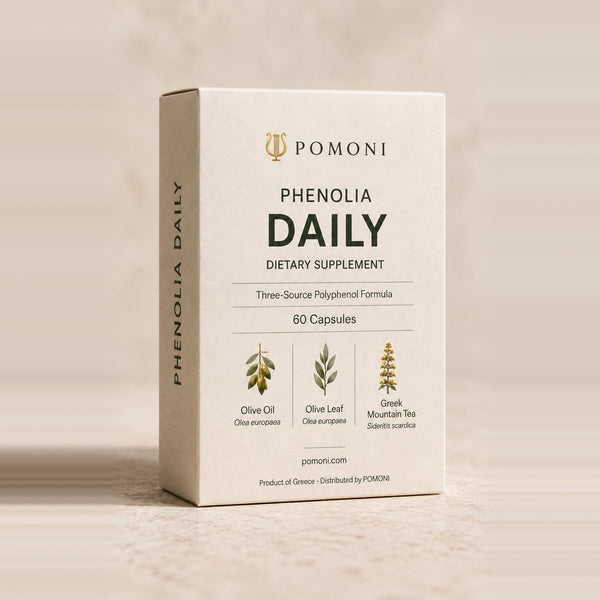
This is where Phenolia Daily comes in. Instead of a capsule filled with liquid oil, Phenolia Daily is a plant-based capsule of powdered high-phenolic olive oil, olive leaf extract and Greek Mountain Tea, with 12 mg of olive polyphenols in each two-capsule serving.
This format changes the daily routine in three ways:
-
A Measured Serving: Each serving is pre-measured, so there is no pouring and no guesswork.
-
No Oil to Swallow: You get olive polyphenols without drinking spoonfuls of oil.
-
Three Greek Sources: Olive oil, olive leaf and Greek Mountain Tea in one capsule.
The Result: A Consistent Daily Serving
Bottled oil, including Pomoni High-Phenolic Olive Oil, still needs good storage: keep it cool, dark and tightly closed, and use it promptly once opened.
When you take Phenolia Daily, you know your serving: 12 mg of olive polyphenols in two capsules. You can see this product in detail at https://pomoni.com/products/pomoni-high-phenolic-olive-oil.
The Economics of Degradation
Why doesn't everyone do this? Why does the industry continue to push liquid oil in clear bottles?
The answer is simple: Economics and Tradition.
Changing the supply chain is expensive. Producing green, early-harvest oil costs more. Turning it into a daily capsule adds another layer of complexity. The mass market is built on volume—selling millions of liters of "good enough" oil.
But "good enough" isn't enough when you are trying to manage cholesterol, reduce inflammation, or protect your brain. Polyphenol degradation turns a medicinal food into a mere calorie source.
At Pomoni, we aren't trying to replace the olive oil you use for sautéing onions. We are offering a specialized tool for your health. We are bridging the gap between food and medicine by fixing the flaws in the delivery system.
How to Spot Degraded Oil (If You Must Buy Liquid)
We understand that you still need liquid oil for culinary enjoyment. If you are shopping for bottled oil, here is how to minimize your exposure to polyphenol degradation:
-
Check the Harvest Date: Do not look at the "Best By" date. Look for a harvest date. If the oil is more than 18 months old, put it back. The polyphenols are gone.
-
Dark Bottles Only: Never buy oil in clear glass or plastic. Light destroys antioxidants in weeks.
-
Small Batches: Buy smaller bottles that you can finish in a month. Do not buy the giant 3-liter tin unless you are cooking for a restaurant.
-
Taste the Bitter: If the oil tastes mild, buttery, and smooth, it lacks polyphenols. It might be fresh, but it isn't potent. You want bitterness and a peppery kick.
The Future of Freshness
We believe the future of nutrition lies in bioavailability and stability. It doesn't matter what nutrients are in the food when it is grown; it matters what nutrients make it into your cells.
Pomoni represents a shift in thinking. We respect the ancient tradition of the olive tree, but we use modern science to perfect it. By identifying the points of failure in the traditional olive oil industry—storage, light, time—we have engineered a way to bypass them.
Our commitment is to transparency and efficacy. We want you to experience the true power of the Mediterranean diet, not a diluted version of it.
If you are tired of guessing whether your olive oil is actually working for you, it is time to switch to a measured daily serving. Explore our high-phenolic capsules and learn more about our science at pomoni.com.
Protecting your health requires protecting your nutrients. Don't let the benefits fade away before you can enjoy them.