
-
ShopLearn
-
Guides
-
The Science
-
Conditions
Recipes-
Sauces
-
Bread and toast
-
Salads and sides
-
Mains
Built For-
The Long Run: endurance athletes
-
The Long Life: 40 and beyond
-
The Long Shift: fire, police, military, trades
-
-
-
ShopLearn
-
Guides
-
The Science
-
Conditions
Recipes-
Sauces
-
Bread and toast
-
Salads and sides
-
Mains
Built For-
The Long Run: endurance athletes
-
The Long Life: 40 and beyond
-
The Long Shift: fire, police, military, trades
-

Unlock 10% off your first order
We use cookies and similar technologies to provide the best experience on our website.

Olive Oil Lab Testing & HPLC Results
Proof, not promises.
Our latest HPLC result: 635 mg/kg total polyphenols (Modern Olives, July 2026). Every certificate is published in full — read them yourself.
Proof, not promises.
Most brands test once and market that number forever. We test every batch by HPLC, publish the certificates with the lab and date, and tell you when the number goes down. Read them yourself below.
What is in the oil, compound by compound
HPLC separates each polyphenol and measures it on its own. These are the 2025-harvest results from both laboratories, in mg/kg.
| Compound | Modern Olives · US 26/453 · Jul 2026 | PharmaGnose · PGRT1580 · Feb 2026 |
|---|---|---|
| Oleocanthal | 111.9 | 243.5 |
| Oleacein | 92.1 | 130.4 |
| Hydroxytyrosol | 40.7 | 22.7 |
| Tyrosol | 31.5 | 29.4 |
| Oleuropein aglycone (various forms) | 4.6–94.6 | — |
| Ligstroside aglycone (various forms) | 12.0–26.2 | — |
| Total polyphenols | 635 | 612 |
Both results exceed the EU health-claim threshold of 5 mg of hydroxytyrosol and its derivatives per 20 g of oil (Regulation (EU) No 432/2012). A dash means the laboratory did not report that compound separately.

Pomoni High-Phenolic Olive Oil
Early-harvest Greek extra virgin olive oil, tested by HPLC every batch. Pour it, cook with it, and read the lab report behind it.
Results by harvest
Four HPLC results across two harvests. Polyphenols decline after pressing, so every figure carries its test date.
| Harvest | Tested | Laboratory | Report | Total polyphenols (HPLC) |
|---|---|---|---|---|
| 2025 (October) | July 2026 | Modern Olives, California | US 26/453 | 635 mg/kg |
| 2025 (October) | February 2026 | PharmaGnose, Greece | PGRT1580 | 612 mg/kg |
| 2024 (October) | October 2025 | Modern Olives, California | US 25/403 | 347 mg/kg |
| 2024 (October) | May 2025 | University of Athens | OLE_1819 | 735 mg/kg |
The two 2025-harvest results agree within 4%. The 2024-harvest pair shows the natural decline over five months of storage.
Polyphenols fade. We won’t pretend they don’t.
Our 2024 harvest tested 735 mg/kg in May 2025 and 347 mg/kg in October 2025, both by HPLC. That’s why we date every test and recommend using the oil within 90 days. A number frozen on a label the day of bottling isn’t the number in your kitchen.
Univ. of Athens, OLE_1819 · mg/kg
Modern Olives, US 25/403 · mg/kg
Why this matters
Polyphenols are living antioxidants — they oxidize slowly from the moment the oil is pressed. Testing once and quoting it indefinitely overstates what you actually consume. We’d rather earn your trust with the real curve than a flattering headline.
Every batch we sell has a dated HPLC certificate

At the mill
Early-October Koroneiki from a single grove in Ariochori, Messinia, cold-extracted at 23 °C and bottled on site.
By HPLC
Polyphenols are measured by HPLC (IOC method COI/T.20/Doc 29) at independent laboratories: Modern Olives (ISO/IEC 17025) and PharmaGnose.
Every batch, dated
Each lot gets its own Certificate of Analysis — lab, report number and test date on every figure we quote.
We test by HPLC — and quote only HPLC
HPLC is the International Olive Council method used to verify the EU health claim: it measures each polyphenol directly. NMR can read two to three times higher for the same oil, so we quote HPLC results only and name the lab and date on every figure.
Independent laboratories, named
We pay for every test. None of these laboratories is owned by Pomoni.
| Laboratory | What it tests for us | Method and accreditation |
|---|---|---|
| Modern Olives California, USA | Oil polyphenols, compound by compound | HPLC, IOC method COI/T.20/Doc 29. ISO/IEC 17025 accredited, with IOC recognition. |
| PharmaGnose S.A. Greece | Oil polyphenols; certificates for the Phenolia extract lots | HPLC, IOC method. A 2013 spin-off of the National and Kapodistrian University of Athens. PharmaGnose also makes our capsule extracts. |
| National and Kapodistrian University of Athens Greece | Oil polyphenols (2024 harvest) | HPLC, report OLE_1819. |
| IEH Analytical Laboratories Seattle, USA | Heavy metals in the Phenolia capsule powder | ISO/IEC 17025:2017 and FDA Laboratory Accreditation for Analysis of Foods, ANAB certificate AT-3177, valid to February 24, 2028. |
| EMA Woodland, California, USA | Pesticides in the Phenolia capsule powder | ISO/IEC 17025 accredited. |
The same standard for the capsules
Each Phenolia capsule provides 6 mg of olive polyphenols, so the 2-capsule serving gives 12 mg. That is about what 1.5 tablespoons (20 g) of a 600 mg/kg oil contains: 20 g × 0.6 mg/g ≈ 12 mg.
Where they are made
Doctors Labs, Greece: a GMP facility licensed by Greece’s National Organization for Medicines (EOF), certified to ISO 22000:2018 by TÜV Austria (valid to July 14, 2027) and registered with the US FDA as a food facility. Final packaging is in Bettendorf, Iowa.
What goes in
High-phenolic olive oil (powdered), olive leaf extract and Greek Mountain Tea (Sideritis scardica), all extracted in Greece by PharmaGnose. Recovery adds beetroot extract.
Capsule shell: hydroxypropyl methylcellulose (plant-based). Other ingredients: microcrystalline cellulose, magnesium stearate, silicon dioxide, arabic gum.
How each lot is checked
- Polyphenol content is calculated from the extract’s certificate of analysis (PharmaGnose, July 2026 lots).
- Heavy metals tested on the capsule powder by IEH.
- Pesticides tested on the capsule powder by EMA.
- Microbiology on the extract lots: total aerobic count under 1,000 CFU/g, yeasts and moulds under 100 CFU/g, E. coli and Salmonella absent, lead within the 3.0 ppm limit.
What is still under way
Finished-capsule HPLC testing of Phenolia Daily and Phenolia Recovery is under way. We will publish those results here, with the lot number and date, as soon as they are issued.

Phenolia Daily
High-phenolic olive oil, olive leaf and Greek Mountain Tea in one plant-based capsule: 12 mg olive polyphenols per two-capsule serving, with the lab report published.
Or see the olive oil →Certificates of Analysis
Independent HPLC and safety reports, by lab and date. Open any of them — we have nothing to hide.
US 26/453 · July 2026
Biophenol profile by HPLC: 635 mg/kg total polyphenols. 2025 harvest.
PGRT1580 · February 2026
Greek biotech spin-off analyzing natural bioactive plant compounds.
US 25/403 · October 2025
Biophenol profile by HPLC: 347 mg/kg. 2024 harvest, twelve months after pressing.
Heavy Metal Testing
Independent IEH laboratory screening for heavy metal contaminants.
Pesticide Testing
Independent EMA multi-residue pesticide screening analysis.
Questions about any result? We’re glad to walk you through it — get in touch.
Every document, by product and lab
| Product | Document | Laboratory | Method | Date |
|---|---|---|---|---|
| Olive oil, 2025 harvest | US 26/453 | Modern Olives | HPLC | July 8, 2026 |
| Olive oil, 2025 harvest | PGRT1580 | PharmaGnose | HPLC | February 11, 2026 |
| Olive oil, 2024 harvest | US 25/403 | Modern Olives | HPLC | October 16, 2025 |
| Olive oil, 2024 harvest | OLE_1819 (PDF to be added) | University of Athens | HPLC | May 2025 |
| Phenolia Daily extract | PGDOLP4S 3_26 (PDF to be added) | PharmaGnose | Extract certificate | July 27, 2026 |
| Phenolia Recovery extract | PGDOLP4BT 1_26 (PDF to be added) | PharmaGnose | Extract certificate | July 27, 2026 |
| Phenolia capsule powder | Heavy metals | IEH Analytical | Heavy metals panel | August 7, 2026 |
| Phenolia capsule powder | Pesticides | EMA | Pesticide screen | August 6, 2026 |
Built to clear the bar that actually means something
Frequently asked
Why does your polyphenol number go down over time?
Polyphenols are antioxidants that oxidize slowly after pressing. Our 2024 harvest tested 735 mg/kg in May 2025 and 347 mg/kg in October 2025, both by HPLC. That’s why we date every test and recommend using the oil within 90 days at room temperature — so you get the real benefit, not a stale label claim.
What’s the difference between HPLC and NMR here?
HPLC directly measures each polyphenol and is the IOC-recognized gold standard; NMR infers content and can read 2–3× higher for the same oil. We quote HPLC results only; earlier NMR reports stay on file. Full explainer →
Who conducts your independent testing?
Polyphenols are measured by HPLC at Modern Olives (California) and PharmaGnose (Greece); the 2024 harvest was also tested at the University of Athens. Heavy metals are tested by IEH Analytical Laboratories and pesticides by EMA. Details are in the laboratory table above.
Do the capsules get tested too?
Yes. Phenolia is screened for banned substances by LGC, and its polyphenol content is calculated from the extract’s certificate of analysis. Finished-capsule HPLC testing is under way. Explore Phenolia →
This is what transparency looks like.
Prove it, then sell it — on every batch, every time.
WHERE TO START
The research is the easy part.
Phenolia Daily puts the polyphenols this article describes into one HPLC-verified capsule — three Greek sources, no oil to sip, zero calories.
Shop Phenolia Daily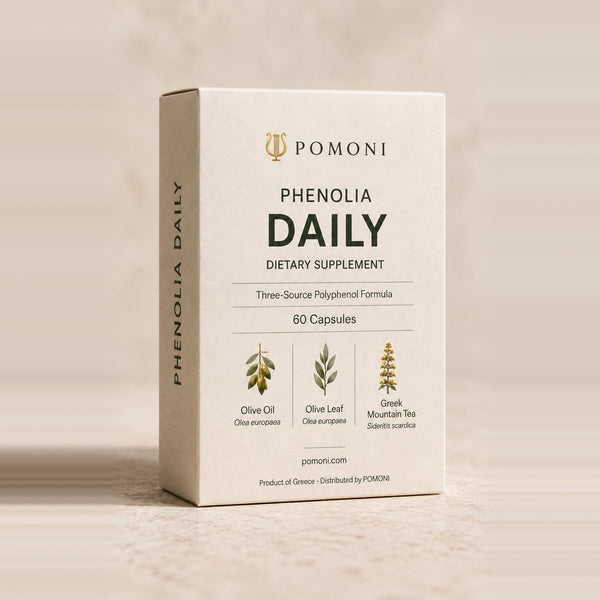
Phenolia Daily — Olive Polyphenol Supplement
From $45/box with Subscribe & Save

Verified olive polyphenols - from a single Greek grove, proven batch by batch. Prove it, then sell it.
O-Liv LLC, doing business as Pomoni · Bettendorf, Iowa
Support