
Unlock 10% off your first order
Real olive oil, explained.
Most oil sold as extra virgin is not. Six things to check before you buy, what the label words mean, and a 60-second taste test.
Real extra virgin olive oil has a harvest date on the label, comes in dark glass or tin, tastes bitter and peppery, and is backed by a lab report you can read. Most of what is sold as "extra virgin" fails at least one of those tests. In the best-known study, the UC Davis Olive Center found that 69 percent of imported supermarket oils labelled extra virgin failed the international sensory standard. This guide is a checklist: six things to look for before you buy, each with a short answer here and a longer article behind it.
Spot the fakes
Read the label
Know the terms
Taste it
Keep it fresh
Why so much olive oil is not what the label says
Olive oil is the most commonly adulterated food in the world after honey and milk, according to the European Union's food fraud reporting. The reasons are simple. Extra virgin oil costs several times more than refined or seed oil, the difference is invisible in the bottle, and the legal tests are slow and rarely run at retail. Fraud takes three forms: refined olive oil or seed oil sold as extra virgin; genuine extra virgin oil that has gone stale and no longer meets the grade; and oil of one origin sold under another flag.
The scale is well documented. In 2010 the UC Davis Olive Center tested imported oils sold as extra virgin in California supermarkets and found that 69 percent failed the International Olive Council sensory standard, most often for rancid or fusty defects, while 10 percent of California-produced oils failed. Later European Commission checks and consumer-group tests in Italy, Spain and the UK have reported failure rates between a fifth and a half depending on the sample. The problem is not rare. It is the default for cheap oil.
The six-point checklist
- Harvest date, not just a best-by date. Olive oil is a fruit juice and it peaks in the months after pressing. A best-by date is set two years from bottling, which can itself be a year after harvest. If the label shows only a best-by date, assume the oil is older than you think. Pomoni prints the harvest month on every bottle.
- Dark glass, tin or an opaque bottle. Light destroys polyphenols and accelerates rancidity. Clear glass on a lit shelf is a sign the producer is not thinking about freshness.
- A named origin, ideally a named grove. "Packed in Italy" or "Product of EU" means the oil was blended from several countries. A single country, region or cultivar on the label is harder to fake and easier to check.
- Bitterness and a peppery sting. Fresh extra virgin oil is bitter on the tongue and catches the throat; that sting is oleocanthal. A smooth, buttery, flavourless oil is either refined or old. The tasting guide shows how professionals check this in 60 seconds.
- A lab report you can open. Free acidity below 0.8 percent is the legal extra virgin limit, but a good oil is well under 0.3. Peroxide value and UV absorbance show freshness; polyphenol content shows potency. Certificates are only worth anything if they are dated to the batch in your hand. Pomoni's are at Testing and Certifications.
- A price that could be true. Early-harvest extra virgin oil yields 10 to 12 litres per 100 kg of olives and is hand-picked and milled within hours. That costs money. A litre of "extra virgin" at the price of seed oil cannot have been made that way.
What the words on the label mean
| Term | What it legally means | What it tells you about quality |
|---|---|---|
| Extra virgin | Mechanically extracted, free acidity under 0.8 percent, no sensory defects by a trained panel | The top grade on paper. In practice widely abused, so it is a starting point, not a guarantee |
| Virgin | Same process, acidity up to 2 percent, minor defects allowed | Rarely sold at retail. Honest but lower quality |
| Olive oil, pure olive oil, light olive oil | Refined olive oil with a little virgin oil added for flavour | Chemically refined. No polyphenols to speak of. "Light" refers to flavour, not calories |
| Cold pressed, cold extracted | Extraction below 27 °C | Required for extra virgin anyway, so it adds nothing. Still a common marketing phrase |
| First cold pressed | No legal meaning with modern centrifuge milling | Pure marketing |
| Unfiltered | Not passed through a filter after milling | Cloudy, more flavour early, but spoils faster. Use within months |
| Early harvest | No legal definition | When true, the single biggest driver of polyphenol content. Needs a harvest date and a lab number to back it |
| PDO, PGI | EU-protected origin and method | Proof of where it came from and how it was made. Not proof of freshness or potency |
| High-phenolic, high-polyphenol | No legal definition; the EU health claim applies above 5 mg per 20 g | Meaningful only with a lab number for the batch. See the high-phenolic guide |
The 60-second taste test
You do not need a panel to catch most bad oil. Pour a tablespoon into a small glass, cup it in your hands for a minute to warm it, cover it, then smell. Fresh oil smells green: cut grass, artichoke, tomato leaf, green banana. Stale oil smells like crayons, putty or old nuts; that is rancidity. Fusty oil smells of fermented olives or sweaty socks. Then sip, pull a little air across the oil, and swallow. Bitterness on the tongue and a peppery catch in the throat are good signs. Smooth, flat and greasy is not. The full method, including the defects to learn, is in what real olive oil should smell and taste like.
How to keep real olive oil real
A good oil can be ruined in a month on the wrong shelf. Keep it closed, cool and dark: a cupboard away from the stove, not the counter and never the windowsill. Do not refrigerate; it is unnecessary and the oil clouds. Buy a size you will finish in six to eight weeks once opened, because oxygen in the half-empty bottle does the rest of the damage. Polyphenol content falls steadily from harvest, and a liquid oil loses roughly 40 percent of its polyphenols within a year even when stored well, which is why harvest date matters more than best-by date. More in how to store olive oil.
What you are paying for
Price does not prove quality, but a low price does disprove it. Early harvest cuts yield by up to half; hand harvesting and same-day milling cost labour; dark glass and nitrogen flushing cost more than clear plastic; and testing every batch costs more than testing none. A 500 mL bottle of genuine early-harvest, lab-tested oil from a named grove sits in the range of a good bottle of wine. Below that, something on the list above has been skipped. The price vs quality article breaks the cost down line by line.
Frequently asked questions
How can I tell if olive oil is fake?
Check for a harvest date, dark packaging and a named origin, then taste it: real extra virgin oil is bitter and peppery, not smooth and flat. The only certain test is a lab report dated to the batch.
Does the fridge test work?
No. Whether olive oil solidifies in the fridge depends on its fatty-acid mix, not on purity, and many real oils never fully solidify while some adulterated ones do. Ignore it.
What does "extra virgin" actually guarantee?
Legally, mechanical extraction, free acidity under 0.8 percent and no sensory defects. In practice the label is widely misused, so treat it as a starting point and check the harvest date, packaging and taste.
Is cloudy olive oil better?
Cloudy means unfiltered. It has slightly more flavour and polyphenols when very fresh but spoils faster. Neither filtered nor unfiltered is more "real".
Does colour tell me anything?
No. Colour depends on cultivar and ripeness, and professional tasters use blue glasses so colour cannot influence them. Green oil is not better than gold oil.
How long does olive oil last?
Unopened and stored well, 12 to 18 months from harvest for flavour, less for polyphenols. Once opened, finish it within six to eight weeks.
Is Greek olive oil more likely to be real?
Greece produces a higher share of extra virgin grade than Italy or Spain and exports much of it in bulk, which is why "Italian" oil is often Greek. Origin alone is not proof; a named grove and a harvest date are. The Greek olive oil guide covers this.
Which certifications matter?
PDO and PGI prove origin and method. Organic proves farming inputs. None of them proves freshness or polyphenol content, which only a dated lab report shows.
Sources
- Frankel EN, Mailer RJ, Shoemaker CF, Wang SC, Flynn JD. Tests indicate that imported "extra virgin" olive oil often fails international and USDA standards. UC Davis Olive Center, July 2010. UC Davis news release, July 2010
- International Olive Council. Trade standard applying to olive oils and olive pomace oils (COI/T.15/NC No 3). internationaloliveoil.org
- Commission Delegated Regulation (EU) 2022/2104 on marketing standards for olive oil.
- Commission Regulation (EU) No 432/2012, olive oil polyphenols health claim.
- Pomoni batch certificates of analysis. Testing and Certifications.

Every Pomoni article on buying real olive oil
Fakes, labels, terms, tasting, storage and price, newest first.

Harvest Date vs Best-By Date on Olive Oil: Which One Matters?
The harvest date matters more than the best-by date, because best-by dates usually count from bottling, which can be months after harvest.
Read →
The Olive Oil Label Checklist: 10 Things to Check Before You Buy
Ten things to check on an olive oil label before you buy, what each one tells you, and what only a lab report can...
Read →
Why Fresh Olive Oil Tastes Different Every Harvest
When you buy a bottle of your favorite soda, you expect it to taste exactly the same today as it did five years ago....
Read →
Olive Oil vs. Seed Oils: What Actually Sets Them Apart
The conversation around olive oil and seed oils has become needlessly extreme. One side presents every seed oil as toxic, while the other treats...
Read →
Does Olive Oil Color Indicate Quality?
Olive oil can range from bright green to pale yellow or deep gold. That color comes from natural pigments in the fruit, but it...
Read →
How Long Olive Oil Really Stays Fresh
We treat many items in our kitchen as immortal. Salt, sugar, vinegar, and honey can sit in the pantry for years without losing their...
Read →
Filtered vs Unfiltered Olive Oil: Pros and Cons
Walk into a gourmet food shop or a local farmers' market, and you might see bottles of olive oil that look completely different from...
Read →
Olive Oil Certifications: What They Do and Do Not Prove
Olive oil packaging can display geographic seals, organic logos, quality-program marks, competition awards, laboratory names, and Certificates of Analysis. These do not all verify...
Read →
Acidity Levels Explained: What Numbers Matter
Acidity is one of the first numbers producers examine when evaluating olive oil. It offers a measurable record of the condition of the fruit...
Read →
Why Bitterness and Peppery Burn Mean High Quality
If you have ever taken a spoonful of premium Extra Virgin Olive Oil (EVOO) and felt a sudden, sharp sting at the back of...
Read →
What Real Olive Oil Should Smell and Taste Like
In a marketplace flooded with colorful labels and "imported from Italy" stamps, a shocking truth remains hidden in plain sight: most people have never...
Read →
How to Taste Olive Oil Like a Professional
Tasting olive oil on its own gives you a clearer view of its aroma, flavor, texture, and finish. Food can soften bitterness, cover defects,...
Read →
Single-Origin vs Blended Olive Oil: What’s the Difference?
Single-origin and blended olive oil are often treated as opposites, with one presented as pure and the other as inferior. The real distinction is...
Read →
Why Price Alone Doesn’t Guarantee Real Olive Oil
When navigating the crowded olive oil aisle, it's a common and seemingly logical assumption: if a bottle is expensive, it must be high-quality. We...
Read →
Why Supermarket Olive Oil Often Fails Quality Tests
You walk into a brightly lit supermarket, determined to make a healthy choice. You head to the oil and vinegar aisle, faced with a...
Read →
Can Olive Oil Go Rancid? Signs Yours Is Already Bad
Can Olive Oil Go Rancid? Signs Yours Is Already Bad Many of us have a bottle of olive oil sitting in our kitchen pantry,...
Read →
Is Your Olive Oil Cut With Seed Oils? How to Know
You purchase a bottle of extra virgin olive oil with the expectation of purity. You trust that the golden-green liquid inside is the unadulterated...
Read →
How to Read an Olive Oil Label (And Spot Red Flags)
Walking down the olive oil aisle can feel overwhelming. You are met with a wall of bottles, all boasting beautiful labels with images of...
Read →
The Olive Oil Fraud Problem: What Consumers Need to Know
Olive oil is a staple in kitchens worldwide, celebrated for its rich flavor and impressive health benefits. When you purchase a bottle of extra...
Read →
How to Tell If Olive Oil Is Real or Fake
Olive oil is a cornerstone of culinary traditions and healthy diets around the world, celebrated for its rich flavor and significant health benefits. From...
Read →
The Global Olive Oil Market: What Shapes Price and Quality
The global olive oil market begins with a seasonal crop, not a factory formula. Every harvest is shaped by rainfall, heat, flowering, pests, fruit...
Read →
2025 Olive Oil Trends: What Health & Gourmet Consumers Want from Organic Extra Virgin Olive Oil
Olive oil has always been a staple of Mediterranean life, but in 2025, it’s becoming something bigger. Around the world, chefs, wellness experts, and...
Read →
Olive Oil Tasting at Home: How to Savor Authentic Olive Oil Like a Pro
There’s a reason olive oil tastings are a tradition across the Mediterranean—they celebrate flavor, craftsmanship, and a deep connection to the land. A true...
Read →
How to Store Olive Oil to Preserve Its Purity and Quality
Olive oil is more than a pantry staple—it’s alive with nutrients that thrive only when properly protected. Light, air, and heat can quietly strip...
Read →WHERE TO START
Harvest date on the bottle. Certificate online.
Pomoni's early-harvest Greek olive oil passes every item on this checklist: named grove, harvest month printed, dark glass, bitter and peppery, and an HPLC certificate for the batch in your hand.
Shop the olive oil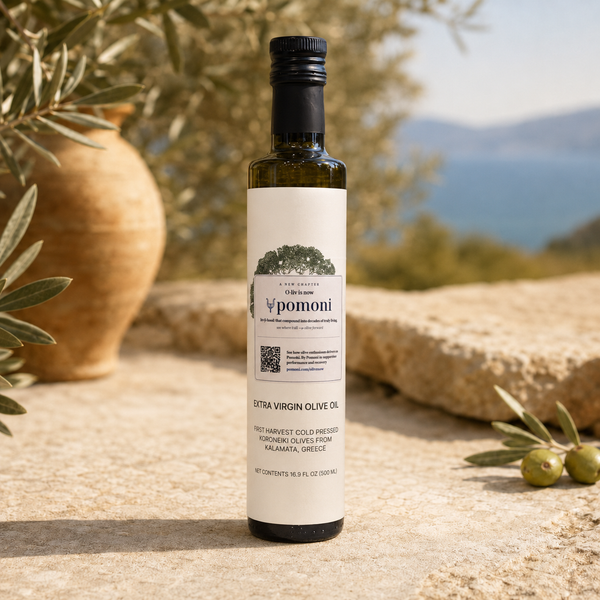
High Phenolic Olive Oil From Greece
From $29.00

Verified olive polyphenols - from a single Greek grove, proven batch by batch. Prove it, then sell it.
O-Liv LLC, doing business as Pomoni · Bettendorf, Iowa
Verified olive polyphenols - from a single Greek grove, proven batch by batch. Prove it, then sell it.
O-Liv LLC, doing business as Pomoni · Bettendorf, Iowa