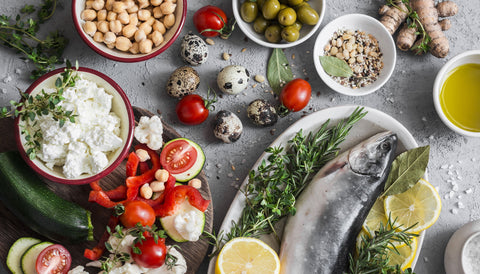
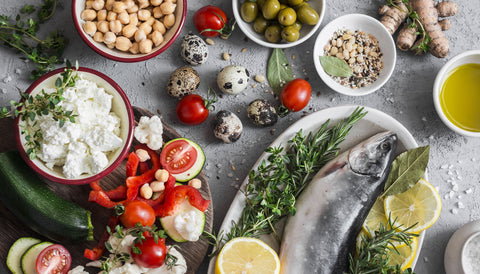
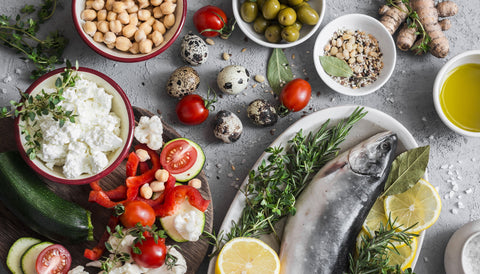
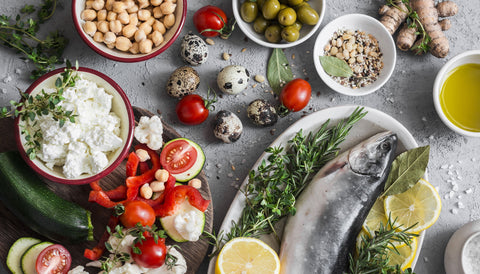
A Mediterranean diet meal plan is built on vegetables, legumes, whole grains, fruit, nuts and fish, with extra virgin olive oil as the main fat. The 7-day plan below follows the published Mediterranean diet pyramid. It uses simple Greek recipes, leftovers on purpose, and one shopping list grouped by aisle. Nothing needs special products or calorie counting.
What are the rules of a Mediterranean diet meal plan?
The plan follows the Mediterranean diet pyramid published by the Mediterranean Diet Foundation expert group (Bach-Faig, 2011). Here are its main points, in plain terms.
- Every main meal: one or two servings of grains, preferably whole grain, two or more servings of vegetables, and one or two servings of fruit. At least one vegetable serving a day should be raw.
- Every day: olive oil as the main added fat, for cooking and dressing. A handful of olives, nuts or seeds. About two servings of dairy, mostly yogurt and cheese. Herbs, garlic and onion in place of extra salt. Water, about 1.5 to 2 litres.
- Every week: fish and shellfish at least twice, white meat about twice, eggs two to four times, and legumes more than twice. Potatoes three times or fewer.
- Small and occasional: red meat under two servings a week, processed meat under one, and sweets kept for special occasions.
The pyramid also includes things that are not food: eating with others, cooking, daily movement of at least 30 minutes, and rest. A meal plan cannot do those for you, but it can leave time for them.
The 7-day Mediterranean diet meal plan
Recipes linked below are from our Greek olive oil recipes. The rest are standard dishes you can make without a recipe. Portions are for one adult; scale to your appetite. Dinners on days 2, 3 and 6 are cooked large so lunch the next day is already made.
Day 1
| Meal | What to eat |
|---|---|
| Breakfast | Greek yogurt with walnuts, berries and a little honey |
| Lunch | Greek salad (choriatiki) with a thick slice of whole-grain bread |
| Dinner | Baked white fish with ladolemono (lemon and olive oil sauce), steamed greens and brown rice |
| Snack | An apple and a small handful of almonds |
Day 2
| Meal | What to eat |
|---|---|
| Breakfast | Egg, tomato and feta toast |
| Lunch | Lentil soup finished with a raw drizzle of olive oil and a squeeze of lemon, with bread |
| Dinner | Rotisserie chicken with lemon, mustard and olive oil sauce, a large green salad and bulgur. Keep the leftover chicken and sauce. |
| Snack | Carrot and cucumber sticks with hummus |
Day 3
| Meal | What to eat |
|---|---|
| Breakfast | Oats cooked in milk, topped with walnuts and chopped dried figs |
| Lunch | Leftover chicken pasta salad with feta and yogurt |
| Dinner | Chickpea and spinach stew with tomato, garlic and olive oil, with bread. Make a double batch. |
| Snack | An orange and a few olives |
Day 4
| Meal | What to eat |
|---|---|
| Breakfast | Boiled egg on toast with olive oil and a piece of fruit |
| Lunch | Leftover chickpea stew with a raw tomato and cucumber salad |
| Dinner | Whole-wheat pasta with basil pesto and cherry tomatoes, side salad |
| Snack | Plain yogurt with a spoon of honey |
Day 5
| Meal | What to eat |
|---|---|
| Breakfast | Greek yogurt with sliced fruit and pistachios |
| Lunch | Kefalonian riganada (tomato, feta and oregano bread) with a white bean salad |
| Dinner | Grilled sardines or salmon with ladolemono, Greek potato salad and boiled greens |
| Snack | Grapes and a small handful of almonds |
Day 6
| Meal | What to eat |
|---|---|
| Breakfast | Two-egg omelet with spinach and feta, cooked in olive oil, with whole-grain toast |
| Lunch | Greek salad with a handful of chickpeas added |
| Dinner | Gigantes: giant white beans baked in tomato, onion, dill and olive oil, with bread and greens. Make enough for tomorrow. |
| Snack | Riganada (oregano bread) to share |
Day 7
| Meal | What to eat |
|---|---|
| Breakfast | Oats with grated apple, cinnamon and walnuts |
| Lunch | Leftover gigantes with a tomato, cucumber and onion salad |
| Dinner | A small lamb or lean beef souvlaki with tzatziki, bulgur and a large salad. This is the week's one red meat meal. |
| Snack | Fresh figs or a pear |
Across the week, that gives fish twice, chicken twice, eggs three times, legumes five or six times, potatoes once and red meat once. Those numbers sit inside the pyramid's weekly ranges. Swap any dinner for another from the same row: fish for fish, beans for beans.
What is a good Mediterranean diet breakfast?
Breakfast in Greece is often small. The pyramid still asks for grain, fruit and some protein. These five cover it and take under ten minutes:
- Greek yogurt with fruit, walnuts or pistachios, and a little honey.
- Whole-grain toast with olive oil, sliced egg and tomato.
- Oats cooked in milk with nuts and fresh or dried fruit.
- A vegetable omelet cooked in olive oil, with bread.
- Bread rubbed with grated tomato, a drizzle of oil and a little feta.
Skip the pastries and sweetened cereals. The pyramid puts sweets at the top, for occasional use.
How much olive oil is in this plan?
Olive oil is the fat in every meal, so it adds up. Greek recipes pour generously. Depending on how freely you pour, most days in this plan land around 2 to 4 tablespoons. That is close to PREDIMED, where the diet screener gave a point for 4 or more tablespoons a day (Schröder, 2011).
Each tablespoon is about 119 calories (USDA, 2019). The point is to use olive oil instead of butter, spreads and other oils, not on top of them. If you want less, use the low end of each recipe. We cover the numbers in detail in how much olive oil per day.
A rough budget: at 3 tablespoons a day, one person uses about 315 mL in a week. A 500 mL bottle lasts most people one to two weeks.
Is this the diet that was tested in PREDIMED?
It follows the same pattern. PREDIMED enrolled 7,447 Spanish adults at high cardiovascular risk. They were assigned a Mediterranean diet with extra virgin olive oil, one with nuts, or a reduced-fat control diet. Over a median of 4.8 years, 3.8% of the olive oil group had a major cardiovascular event, against 4.4% of controls (Estruch, 2018).
That result came from a whole way of eating, supported by regular dietitian sessions. No single food in this plan carries it alone. For the wider picture after 40, see our pillar guide, eating for longevity: the Mediterranean way after 40.
Mediterranean diet shopping list
This list covers the full week for one person, with leftovers. Buy fish and greens for the first half of the week, then top up mid-week.
| Aisle | What to buy |
|---|---|
| Produce | Tomatoes, cherry tomatoes, cucumbers, onions, garlic, green pepper, spinach, salad greens, cooking greens (chard or kale), carrots, potatoes, lemons, apples, oranges, grapes, pears or figs, berries, fresh basil, parsley and dill |
| Bakery and grains | Whole-grain bread, rolled oats, brown rice, bulgur, whole-wheat pasta |
| Canned and dried legumes | Lentils, chickpeas, white beans, giant beans (gigantes or butter beans), hummus, canned tomatoes |
| Dairy and eggs | Plain Greek yogurt, feta, milk, a small piece of parmesan, eggs (about 6) |
| Fish and meat | White fish fillets, sardines or salmon, one rotisserie chicken, a small piece of lamb or lean beef |
| Nuts and dried fruit | Walnuts, almonds, pistachios, pine nuts, dried figs |
| Oils, vinegars and jars | Extra virgin olive oil (500 mL or more), red wine or apple cider vinegar, Dijon mustard, Kalamata olives, capers, honey |
| Herbs and spices | Dried oregano, cinnamon, black pepper, flaky sea salt |
The oil is the one item worth choosing with care. Look for a harvest date, a dark bottle and, ideally, a published lab report. Our real olive oil buying guide explains what to check on the label.
How do you keep this up after the first week?
Repeat what worked and rotate the rest. Most people settle on three or four breakfasts and a dozen dinners. Keep cooking once and eating twice. Keep canned beans, oats, nuts and a good bottle of oil in the cupboard, so a Mediterranean meal is always the easy option.
If you want an oil with a measured polyphenol content, Pomoni's Greek early-harvest extra virgin olive oil tested at 635 mg/kg total polyphenols by HPLC. The lab details are on the product page.
Sources
- Bach-Faig A, Berry EM, Lairon D, et al. Mediterranean diet pyramid today. Science and cultural updates. Public Health Nutrition. 2011;14(12A):2274–2284. doi.org/10.1017/S1368980011002515
- Estruch R, Ros E, Salas-Salvadó J, et al. Primary prevention of cardiovascular disease with a Mediterranean diet supplemented with extra-virgin olive oil or nuts. New England Journal of Medicine. 2018;378(25):e34. doi.org/10.1056/NEJMoa1800389
- Schröder H, Fitó M, Estruch R, et al. A short screener is valid for assessing Mediterranean diet adherence among older Spanish men and women. Journal of Nutrition. 2011;141(6):1140–1145. doi.org/10.3945/jn.110.135566
- U.S. Department of Agriculture, Agricultural Research Service. FoodData Central, SR Legacy: Oil, olive, salad or cooking (FDC ID 171413). 2019. fdc.nal.usda.gov