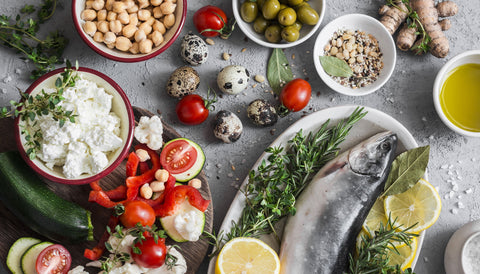
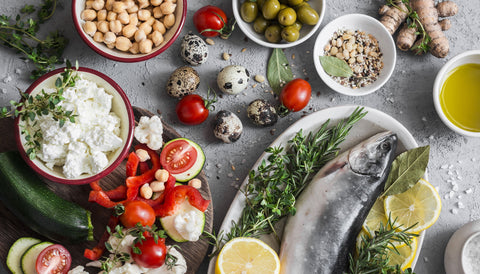
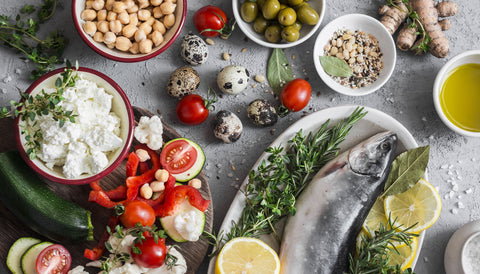
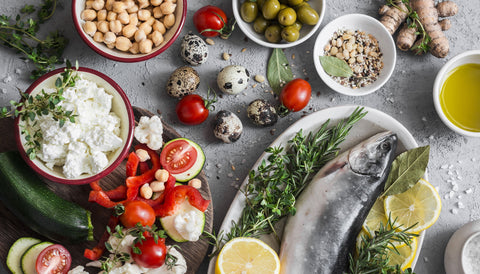
Older people on Ikaria eat a traditional Greek island diet: vegetables, wild greens and potatoes cooked in olive oil, plus fruit, legumes, some fish and little meat. Coffee, tea and local wine are daily habits. In the IKARIA study, residents over 80 scored about 38 out of 55 on a Mediterranean diet score. The diet comes bundled with daily activity, naps and close social ties. The studies show associations, not proof that any one food explains how long Ikarians live.
What do people on Ikaria actually eat?
The best data come from the IKARIA study, run by cardiologists from the University of Athens. In 2009 they enrolled 1,420 residents aged 30 and over. A 2011 report looked closely at the 187 people older than 80 (Panagiotakos et al., 2011).
Their average Mediterranean diet score was 38 out of 55, which the authors called good adherence. They noted one difference from the textbook pattern: more potatoes. They also described green vegetables eaten as a main meal, usually cooked in olive oil. Fruit and vegetable intake often exceeded dietary recommendations.
The table shows the food frequency answers from that group, exactly as reported. These are questionnaire answers, so treat them as a rough picture rather than a measured menu.
| IKARIA study, people over 80 | Men (n = 89) | Women (n = 98) |
|---|---|---|
| Mediterranean diet score (0–55) | 38 | 38 |
| Energy intake, kcal per day | 1,425 | 1,087 |
| Olive oil, times per week | 6.8 | 5.3 |
| Fruit, times per week | 5.5 | 3.9 |
| Vegetables and salads, times per week | 4.8 | 3.5 |
| Potatoes, times per week | 3.3 | 3.1 |
| Fish, times per week | 2.1 | 1.5 |
| Legumes, times per week | 2.0 | 1.3 |
| Red meat and products, times per week | 1.8 | 1.2 |
| Sweets, times per week | 1.2 | 1.3 |
| Coffee, mL per day | 339 | 293 |
| Tea, mL per day | 109 | 97 |
| Alcohol, mL per day | 186 | 117 |
| Daily siesta | 84% | 67% |
Two things stand out. Calorie intake was modest. And the plate was built on plants and olive oil, with meat and sweets in a small supporting role.
Wild greens: the bitter part of the Ikaria diet
Ikarians gather wild greens, known in Greek as chorta. In 31 interviews on the island, ethnobotanists documented 56 wild green plants and how they are cooked (Pieroni et al., 2023). Most were described as bitter, and most were eaten cooked. The list overlapped heavily with the greens eaten on Crete and in Sicily.
Boiled greens dressed with olive oil and lemon are a common Greek dish. If you cannot forage, dandelion, chicory, mustard greens and escarole are close substitutes.
What has the IKARIA study linked with heart health?
The IKARIA researchers re-examined 673 residents aged 65 to 100 four years after enrolment. Coffee and tea, fruit, and using olive oil as the only added fat were each linked with fewer new cases of cardiovascular disease (Chrysohoou et al., 2016).
Two smaller analyses point the same way. Among 142 residents aged 66 to 91, heavier coffee drinkers had better blood vessel function on ultrasound. Most drank boiled Greek coffee (Siasos et al., 2013). In 538 older residents, a higher Mediterranean diet score went with lower uric acid in men, but not in women (Chrysohoou et al., 2011).
All of these are observational. They show which habits travel together with better markers. They cannot show that coffee, fruit or olive oil caused the difference.
Are Ikarians free of disease?
No. A Franco-Greek team examined 71 residents aged 90 and over, with an average age of 94 (Legrand et al., 2019). Hypertension was diagnosed in 70.4%, diabetes in 19.7% and obesity in 17.2%. Two thirds had at least one chronic disease.
A separate IKARIA analysis of 1,410 adults found two or more chronic diseases in 51% of men and 65.5% of women (Foscolou et al., 2021). Long life on Ikaria seems to mean living well with ageing, not escaping it.
It is not only the food
When the same Franco-Greek team asked the over-90s about daily life, the social picture was striking (Legrand et al., 2021):
- 77.9% had social contact every day.
- 71.8% had moderate or high physical activity levels.
- 62.0% attended panigiria, the island's village festivals.
- Farming was the most common job, and a significant share kept working past retirement age.
Two findings cut against the popular story. Adherence to the Mediterranean diet in this group was 62.7%, which the authors called "less convincing" than the social results. And 54.9% never practised Greek Orthodox fasting, often cited as an Ikaria secret.
The 2011 IKARIA report also found that people who napped regularly had lower depression scores. The authors listed activity, diet, not smoking and midday naps as possible "secrets", and called for more research on which matter most.
Is Ikaria really a Blue Zone?
"Blue Zones" is a popular label, not a medical category. It describes regions with unusually high concentrations of centenarians. Demographers Michel Poulain and Anne Herm list four validated zones: Okinawa, Sardinia, Nicoya and Ikaria. Their method requires strict age checks and longevity at least 50% above the national average (Poulain and Herm, 2025).
A 2025 scoping review of 65 studies found Ikaria shows high life expectancy. It judged Okinawa, Sardinia and Nicoya better characterised, while some other proposed zones lack evidence (Candal-Pedreira et al., 2025).
There are critics. A preprint by Saul Newman, not yet peer reviewed, argues that extreme age records often reflect poor birth registration, error or pension fraud. It reports that the designated zones of Sardinia, Okinawa and Ikaria had lower incomes and shorter life expectancy than their national averages (Newman, 2019). Blue Zone researchers answer that their strict age validation is designed to catch exactly these problems (Poulain and Herm, 2025).
Even supporters are cautious about diet. A review co-written by Poulain warns that a diet being common in a long-lived group does not prove it caused the longevity. It also notes that these diets have changed over time (Pes et al., 2022).
The fair summary: Ikaria's older population is real and well studied. How much of its longevity comes from food, and how exceptional it is, are still debated.
How to eat more like Ikaria at home
You do not need an island. The pattern in the studies translates into a few plain habits:
- Make vegetables the main course. Cook greens, beans and potatoes in olive oil. A proper Greek salad is a start.
- Use olive oil as your main added fat. In the IKARIA follow-up, exclusive olive oil use was one of the habits linked with fewer new heart problems. Our guide to Greek olive oil explains what to look for.
- Eat legumes and fish a couple of times a week. Dress fish simply, as in this ladolemono lemon and olive oil sauce.
- Keep meat and sweets small. Both appeared about once or twice a week.
- Move, rest and eat with people. These habits travelled with the diet in every Ikaria study.
For how this fits a wider plan after 40, see our pillar guide, eating for longevity the Mediterranean way. Pomoni makes a Greek early-harvest olive oil, measured at 635 mg/kg total polyphenols by HPLC; see Pomoni High-Phenolic Olive Oil.
Sources
- Panagiotakos DB, Chrysohoou C, Siasos G, et al. Sociodemographic and lifestyle statistics of oldest old people (>80 years) living in Ikaria island: the Ikaria study. Cardiology Research and Practice. 2011;2011:679187. doi.org/10.4061/2011/679187
- Pieroni A, Morini G, Piochi M, et al. Bitter is better: wild greens used in the Blue Zone of Ikaria, Greece. Nutrients. 2023;15(14):3242. doi.org/10.3390/nu15143242
- Chrysohoou C, Pitsavos C, Lazaros G, et al. Determinants of all-cause mortality and incidence of cardiovascular disease (2009 to 2013) in older adults: the Ikaria study of the Blue Zones. Angiology. 2016;67(6):541–548. doi.org/10.1177/0003319715603185
- Siasos G, Oikonomou E, Chrysohoou C, et al. Consumption of a boiled Greek type of coffee is associated with improved endothelial function: the Ikaria study. Vascular Medicine. 2013;18(2):55–62. doi.org/10.1177/1358863X13480258
- Chrysohoou C, Skoumas J, Pitsavos C, et al. Long-term adherence to the Mediterranean diet reduces the prevalence of hyperuricaemia in elderly individuals, without known cardiovascular disease: the Ikaria study. Maturitas. 2011;70(1):58–64. doi.org/10.1016/j.maturitas.2011.06.003
- Legrand R, Manckoundia P, Nuemi G, Poulain M. Assessment of the health status of the oldest olds living on the Greek island of Ikaria: a population based-study in a Blue Zone. Current Gerontology and Geriatrics Research. 2019;2019:8194310. doi.org/10.1155/2019/8194310
- Foscolou A, Chrysohoou C, Dimitriadis K, et al. The association of healthy aging with multimorbidity: IKARIA study. Nutrients. 2021;13(4):1386. doi.org/10.3390/nu13041386
- Legrand R, Nuemi G, Poulain M, Manckoundia P. Description of lifestyle, including social life, diet and physical activity, of people ≥90 years living in Ikaria, a longevity Blue Zone. International Journal of Environmental Research and Public Health. 2021;18(12):6602. doi.org/10.3390/ijerph18126602
- Poulain M, Herm A. Blue Zone, a demographic concept and beyond. American Journal of Lifestyle Medicine. 2025. doi.org/10.1177/15598276251342502
- Candal-Pedreira C, Rey-Brandariz J, Martín-Gisbert L, et al. Blue Zones, an analysis of existing evidence through a scoping review. Aging and Disease. 2025. doi.org/10.14336/AD.2025.0461
- Newman SJ. Supercentenarian and remarkable age records exhibit patterns indicative of clerical errors and pension fraud. bioRxiv preprint, not peer reviewed. 2019. doi.org/10.1101/704080
- Pes GM, Dore MP, Tsofliou F, Poulain M. Diet and longevity in the Blue Zones: a set-and-forget issue? Maturitas. 2022;164:31–37. doi.org/10.1016/j.maturitas.2022.06.004