

Unlock 10% off your first order
Meet oleocanthal, the peppery olive compound.
That catch at the back of your throat from a truly fresh olive oil? It has a name — and a research story about how the body manages its own inflammatory response.

Phenolia Daily
High-purity Mediterranean olive oil, olive leaf and Greek Mountain Tea in one plant-based capsule: 12 mg olive polyphenols per two-capsule serving, with the lab report published.
The sting is the science.
In 2005, researchers noticed that fresh olive oil irritated the throat in the same peculiar way as liquid ibuprofen. That shared sensation led them to a single olive polyphenol — oleocanthal.
The peppery signal
Oleocanthal produces the throat-catch of genuine early-harvest oil. Little sting, little oleocanthal.
The ibuprofen parallel
In laboratory research, oleocanthal was found to act on some of the same COX enzymes as ibuprofen — a natural molecule studied for a similar mechanism.
A balanced response
The interest is not about masking pain. It is about supporting the body’s own healthy inflammatory balance, day after day.

Picked early, when the polyphenols peak.
Oleocanthal is highest in olives picked early — before they fully ripen — and pressed within hours, before the compound fades. Our olives are Koroneiki, early-harvest, from a single Greek grove.
Phenolia captures that fraction as a stable powder and pairs it with olive leaf and Greek Mountain Tea, so the polyphenol panel is broader than any one source alone.

Pomoni High-Phenolic Olive Oil
Early-harvest Greek extra virgin olive oil, tested by HPLC every batch. Pour it, cook with it, and read the lab report behind it.
Chronic, low-grade inflammation sits underneath much of how we age. Olive polyphenols are studied for helping keep that everyday response in balance.
Not a drug, and not a substitute for one — a food-derived compound with a genuinely interesting research story.
Frequently asked
Is oleocanthal the same as ibuprofen?
No. Oleocanthal is a natural olive compound that laboratory research found acts on some of the same enzymes as ibuprofen. It is not a drug and not a substitute for one.
How much oleocanthal is in Phenolia?
Exact amounts are printed on every box label and documented in the extract’s certificate of analysis. See our testing & certifications.
Will this help my joint pain or arthritis?
We cannot make that claim. Olive polyphenols are studied for supporting a healthy inflammatory response, not for treating any condition. For a medical concern, talk with your physician.
These statements have not been evaluated by the Food and Drug Administration. This product is not intended to diagnose, treat, cure, or prevent any disease.
Inflammation, briefly
Acute inflammation is the body's short, local response to an injury or infection: redness, heat and swelling that settle once the tissue has healed. Chronic low-grade inflammation is different. It is a quiet, persistent state that researchers track through blood markers such as C-reactive protein (CRP), interleukin-6 (IL-6) and tumor necrosis factor-alpha (TNF-α). Raised markers are linked with many long-term conditions, which is why diet studies often measure them.
The compounds involved
- Oleocanthal gives fresh oil its peppery sting. In laboratory tests it inhibits the COX-1 and COX-2 enzymes, the same targets as ibuprofen (Beauchamp et al., 2005).
- Oleacein, a close relative, has been studied in cell experiments for its effects on inflammatory signalling.
- Hydroxytyrosol is best known as an antioxidant and is the basis of the EU health claim for olive polyphenols.
Most of what is known about how these compounds act comes from laboratory work. Human studies measure what happens to markers after people eat the oil.
What human studies have measured
Over months: the PREDIMED diet trial
In an early PREDIMED report, adults at high cardiovascular risk were assigned to a Mediterranean diet supplemented with virgin olive oil, the same diet with nuts, or a low-fat diet. After three months, C-reactive protein fell in the olive oil group compared with the low-fat group, by an average of 0.54 mg/L (Estruch et al., 2006). This was a whole-diet trial, so the change cannot be credited to olive polyphenols alone.
Within hours: a single serving
In a small study of people with metabolic syndrome, a breakfast made with phenol-rich virgin olive oil changed the activity of inflammation-related genes in blood cells over the following hours, compared with the same breakfast made with low-phenol oil (Camargo et al., 2010). Short-term marker studies like this show that the oil's phenolic content matters; they do not show a lasting health effect.
Phenolic content makes the difference
Trials that compare olive oils differing only in phenolic content help separate the polyphenols from the fat. In the EUROLIVE trial, markers of LDL oxidation fell as the oils' phenolic content rose (Covas et al., 2006). This is why we publish an HPLC result for every batch: our current oil measured 635 mg/kg total polyphenols by HPLC.
Joints and the gut
Joint and digestive health are where people most often ask about olive oil and inflammation. Most of the oleocanthal research on joints is laboratory work, and human studies are small, so we cannot say olive oil treats arthritis or any other condition. Our article on an anti-inflammatory diet for joint pain sets out what has been studied.
Much of the polyphenol content of olive oil reaches the colon, where it interacts with gut bacteria. That research is early; our article on olive polyphenols and gut health summarizes it.
Olive oil and seed oils
Seed oils such as sunflower and corn oil are rich in linoleic acid, an omega-6 fat, while olive oil is mostly oleic acid, a monounsaturated fat. Omega-6 fats are often described as inflammatory, but a systematic review of controlled trials in healthy adults found that eating more linoleic acid did not raise inflammatory markers (Johnson and Fritsche, 2012). The case for extra virgin olive oil rests on what it brings, its phenolic compounds and its place in a Mediterranean-style diet, rather than on fear of other oils.
Olive oil, fish oil and turmeric
These are often compared, but they are not interchangeable. Fish oil supplies the omega-3 fats EPA and DHA. Turmeric supplies curcumin, which the body absorbs poorly on its own. High-phenolic olive oil supplies oleocanthal, oleacein and hydroxytyrosol. They contain different compounds that act in different ways, and one is not simply better than another; many people include more than one in a varied diet. Our comparison of olive polyphenols and fish oil goes into more detail.
Habits that matter alongside diet
No single food sets the body's inflammatory balance. The habits most consistently linked with healthier inflammation markers are the everyday ones:
- Regular movement, combining aerobic activity and strength work.
- Enough sleep, most nights.
- Not smoking.
- A Mediterranean-style eating pattern built on vegetables, legumes, fruit, whole grains, fish and olive oil, with fewer highly processed foods.
- Ways to manage ongoing stress.
Medicines and safety
Olive oil is a normal food, but concentrated polyphenol products deserve the same care as any supplement. In a small trial in healthy men, a single serving of oleocanthal-rich olive oil reduced platelet aggregation within hours (Agrawal et al., 2017). If you take blood thinners, anti-inflammatory drugs or other regular medication, or you are pregnant or nursing, talk with your doctor before adding a supplement. Olive polyphenols are not a substitute for prescribed treatment.
References
- Beauchamp GK, Keast RSJ, Morel D, et al. Ibuprofen-like activity in extra-virgin olive oil. Nature. 2005;437:45-46. doi.org/10.1038/437045a
- Estruch R, Martínez-González MA, Corella D, et al. Effects of a Mediterranean-style diet on cardiovascular risk factors: a randomized trial. Annals of Internal Medicine. 2006;145:1-11. doi.org/10.7326/0003-4819-145-1-200607040-00004
- Camargo A, Ruano J, Fernandez JM, et al. Gene expression changes in mononuclear cells in patients with metabolic syndrome after acute intake of phenol-rich virgin olive oil. BMC Genomics. 2010;11:253. doi.org/10.1186/1471-2164-11-253
- Covas MI, Nyyssönen K, Poulsen HE, et al. The effect of polyphenols in olive oil on heart disease risk factors: a randomized trial. Annals of Internal Medicine. 2006;145:333-341. doi.org/10.7326/0003-4819-145-5-200609050-00006
- Johnson GH, Fritsche K. Effect of dietary linoleic acid on markers of inflammation in healthy persons: a systematic review of randomized controlled trials. Journal of the Academy of Nutrition and Dietetics. 2012;112:1029-1041. doi.org/10.1016/j.jand.2012.03.029
- Agrawal K, Melliou E, Li X, et al. Oleocanthal-rich extra virgin olive oil demonstrates acute anti-platelet effects in healthy men in a randomized trial. Journal of Functional Foods. 2017;36:84-93. doi.org/10.1016/j.jff.2017.06.046
WHERE TO START
One formula, three polyphenol sources.
Phenolia Daily brings oleocanthal-rich olive extract together with olive leaf and Greek Mountain Tea — no oil to sip, zero calories.
Shop Phenolia Daily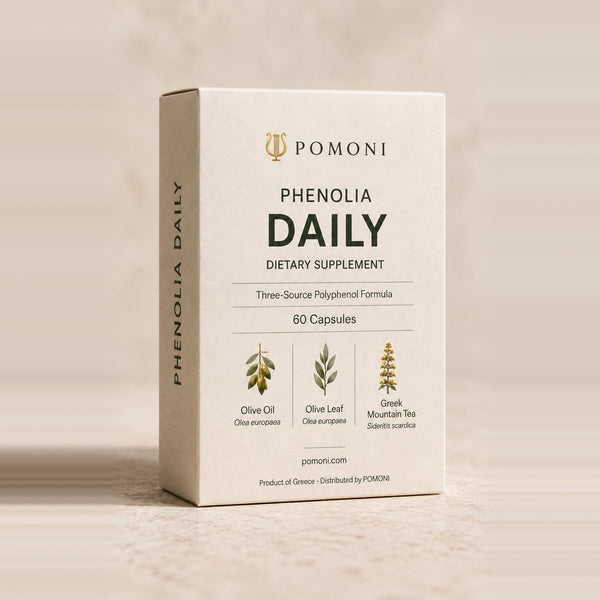
Phenolia Daily — Olive Polyphenol Supplement, 60 Capsules
From $45/box with Subscribe & Save


Verified olive polyphenols - from a single Greek grove, proven batch by batch. Prove it, then sell it.
O-Liv LLC, doing business as Pomoni · Bettendorf, Iowa
Verified olive polyphenols - from a single Greek grove, proven batch by batch. Prove it, then sell it.
O-Liv LLC, doing business as Pomoni · Bettendorf, Iowa