Polyphenols in olive oil are measured in milligrams per kilogram (mg/kg), and extra virgin olive oils range from under 100 to well over 1,000 mg/kg. In a 2024 study, extra virgin oils sold at US retail averaged about 274 mg/kg by the IOC HPLC method. An 11-year study of 5,764 Greek oils averaged 483 mg/kg by NMR, and its authors call oil above 500 mg/kg "high phenolic". The EU health-claim threshold works out to 250 mg/kg. Refined olive oil has very little.
What does mg/kg mean on olive oil?
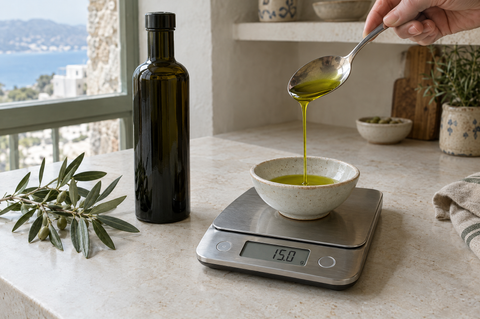
It is milligrams of polyphenols in a kilogram of oil, the same as parts per million. A tablespoon of olive oil weighs about 13.5 g, so an oil at 500 mg/kg carries about 6.75 mg of polyphenols per tablespoon, and one at 250 mg/kg about half that. The EU health claim is written per serving instead: at least 5 mg of hydroxytyrosol and its derivatives in 20 g of oil, which is the same concentration as 250 mg/kg.
Polyphenol levels in olive oil at a glance
| Level | mg/kg | What it means |
|---|---|---|
| Refined and "light" olive oil | Very low | Refining strips out most phenolic compounds |
| Older literature range for extra virgin oil | Usually 100–300 | By the older Folin-Ciocalteu method, as reviewed by Diamantakos et al. (2021) |
| EU health-claim threshold | 250 | 5 mg of hydroxytyrosol and its derivatives per 20 g (Regulation (EU) No 432/2012) |
| US retail extra virgin, 2024 average | About 274 (range 156–440) | IOC HPLC method, NAOOA testing study (see the caveat below) |
| Greek oils, 11-year average | 483 | NMR, 5,764 samples; 74% were above 250 (Diamantakos et al., 2021) |
| "High phenolic" | Above 500 | A research definition, not a legal one |
| "Exceptionally high phenolic" | Above 1,200 | The top 5% of the Greek samples |
The US retail figure comes from a study funded by the North American Olive Oil Association, and its authors note that the tested subset leaned towards samples with questionable grade results. Treat it as a rough baseline, not a national average.
Why the same oil can show different numbers
The test method. The International Olive Council's HPLC method (COI/T.20/Doc. No 29) expresses results as tyrosol, and the IOC itself notes this "may underestimate the true value". NMR, the method used by the University of Athens and the World Olive Center for Health, reads the main bitter compounds directly. In a five-laboratory comparison of 30 oils, the NMR protocol read on average 1.77 mg per 20 g higher than the reference HPLC method, about 88 mg/kg (Tsimidou et al., 2019). One brand that publishes both on the same oil reports 874 mg/kg by HPLC and 1,046 mg/kg by NMR. Our guide to HPLC vs NMR goes deeper.
Time. Polyphenols decline after pressing. In the Greek study, closed bottles at room temperature lost on average 46% in 12 months (Diamantakos et al., 2021). A number measured at harvest describes the oil on that day.
The olive and the harvest. Variety, ripeness and milling speed all move the number. Green, early-harvest olives usually give higher figures than ripe fruit.
What is being counted. "Total polyphenols", "total biophenols", "oleocanthal plus oleacein" and "hydroxytyrosol and derivatives" are different totals. Check which one a label quotes.
How to read a polyphenol number on a label
- Find the method. Compare HPLC with HPLC and NMR with NMR. A number with no method is a marketing figure.
- Find the date. Look for the harvest and the test date. A two-year-old result says little about the bottle in your kitchen.
- Find the lab. A named laboratory and a report you can open beat a number on a bottle.
- Match the batch. The certificate should cover the harvest or lot you are buying.
Our comparison of high-polyphenol brands by lab result applies these checks to the numbers brands publish.
Where does Pomoni's oil sit?
Pomoni's 2025-harvest early-harvest Koroneiki oil measured 635 mg/kg total polyphenols by HPLC at Modern Olives, California, in July 2026, and 612 mg/kg at PharmaGnose, Greece, in February 2026. The 2024 harvest measured 735 mg/kg in May 2025 and 347 mg/kg in October 2025, which shows the decline with age. Every certificate is on our testing page, with the lab and date.
Frequently asked questions
How many polyphenols are in extra virgin olive oil?
It varies widely. A 2024 US retail study averaged about 274 mg/kg by HPLC, and an 11-year Greek study averaged 483 mg/kg by NMR. Individual oils range from under 100 to over 1,000 mg/kg.
What counts as high polyphenol olive oil?
There is no legal definition. Researchers at the University of Athens use above 500 mg/kg for "high phenolic". The EU health-claim threshold is lower, at 250 mg/kg.
How many polyphenols are in a tablespoon of olive oil?
About 13.5 mg per 1,000 mg/kg. An oil at 500 mg/kg gives roughly 6.75 mg per tablespoon; one at 250 mg/kg about 3.4 mg.
Do polyphenols in olive oil go down over time?
Yes. Greek researchers found an average 46% drop over 12 months in closed bottles at room temperature. Cool, dark storage slows the loss.
Sources
- Diamantakos P, et al. Large-scale statistical data of Greek olive oils analysed by qNMR. Molecules 2021;26(4):1115. doi:10.3390/molecules26041115
- Tsimidou MZ, et al. Interlaboratory comparison of protocols for hydroxytyrosol and tyrosol in virgin olive oil. Molecules 2019;24(13):2429. doi:10.3390/molecules24132429
- International Olive Council. Determination of biophenols in olive oils by HPLC, COI/T.20/Doc. No 29/Rev.2, 2022. internationaloliveoil.org
- Kyriakides TC. 2024 Olive Oil Testing Study Report. North American Olive Oil Association, 2025. aboutoliveoil.org
- Commission Regulation (EU) No 432/2012. eur-lex.europa.eu