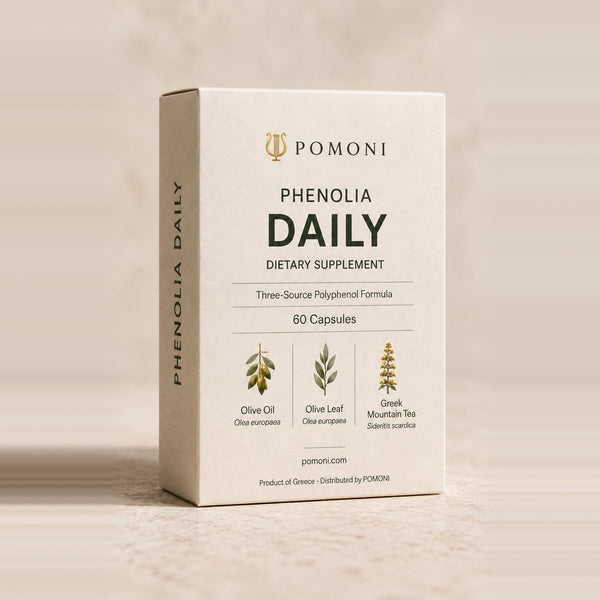
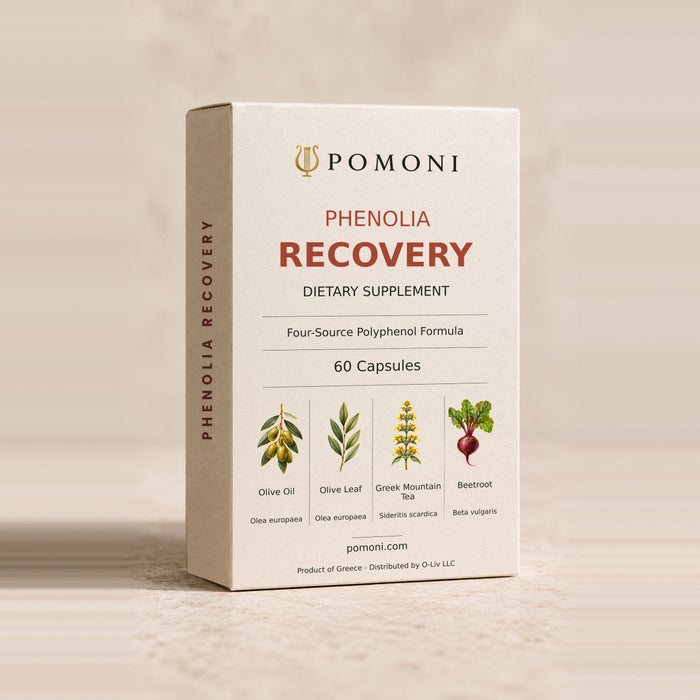
Gundry MD Polyphenol-Rich Olive Oil is a Moroccan extra virgin olive oil sold on the claim that it has about 30 times more polyphenols than ordinary olive oil, but Gundry MD does not publish a polyphenol number, a test method or a lab report to check that against. The one independent figure we found, a 2021 test commissioned by Olive Oil Times, measured 561 to 612 mg/kg. That is high-phenolic territory, similar to several oils that do publish dated certificates. Here is how it compares, using only published information. We make Pomoni, which is one of the oils compared.
What does Gundry MD claim?
The claim has been worded in several ways in Gundry MD's own press releases:
- April 2022: "30 times more polyphenols than a typical 'store-bought' olive oil", and in the same release, "30 times more hydroxytyrosol than typical olive oils" (PR Newswire, 2022).
- December 2024: "up to 30 times more hydroxytyrosol polyphenols than standard olive oils" (PR Newswire, 2024).
Two things are worth noticing. The claim moves between total polyphenols and one compound, hydroxytyrosol, which are different measurements. And the comparison oil, "typical store-bought" or "standard", is not defined. A multiplier is only as meaningful as its baseline, and without a published number for either side it cannot be checked.
Has anyone tested Gundry MD olive oil?
In February 2021, the trade publication Olive Oil Times reported that it had commissioned two analyses of Gundry MD's oil, which found total phenolic content of 561 to 612 mg/kg. It did not name the laboratory or method (Olive Oil Times, 2021). Those samples are from around the 2020 harvest, so they say nothing certain about today's bottles.
For scale: 561 to 612 mg/kg is above the 500 mg/kg that University of Athens researchers use to define "high phenolic", and roughly twice the 274 mg/kg average for extra virgin oils at US retail in a 2024 HPLC study. It is not 30 times an ordinary extra virgin olive oil.
Gundry MD vs high-phenolic olive oils that publish results
| Gundry MD | Pomoni (ours) | Typical published high-phenolic oil | |
|---|---|---|---|
| Polyphenol figure | Not published (561–612 mg/kg in a 2021 press-commissioned test) | 635 mg/kg (July 2026) and 612 mg/kg (February 2026) | About 500–1,300 mg/kg, depending on brand and method |
| Test method | Not published | HPLC, IOC method | HPLC or NMR, stated |
| Laboratory and certificate | Not published | Modern Olives (US 26/453) and PharmaGnose (PGRT1580), published | Usually published |
| Harvest stated | Not in the materials we could check | October 2025 | Usually |
| Origin and olive | Morocco; variety not stated | Greece; early-harvest Koroneiki, single grove | Varies |
For brand-by-brand figures, see high-polyphenol olive oil brands compared by lab result.
Why the "desert olive" story is not the whole story
Olive trees under heat and drought stress can make more phenolic compounds, and that is part of why some Moroccan and other hot-climate oils test high. But growing conditions are only one factor. Variety, how green the olives are at picking, how fast they are milled, and how long the oil has been stored all move the number, often by more. That is why a dated lab result for the batch beats a story about where the trees grow, for any brand, including ours.
How to judge any polyphenol claim
- Ask for the number, not the multiplier. "30x" or "45x" means nothing without the mg/kg on both sides.
- Ask which measurement. Total polyphenols, hydroxytyrosol, and oleocanthal plus oleacein are different totals.
- Ask for the method and lab. HPLC and NMR give different figures for the same oil.
- Ask for the date. Polyphenols fall with age, so an old result overstates a bottle today.
Our guide to polyphenol levels in olive oil explains each step, and the high-phenolic olive oil guide covers the rest.
Frequently asked questions
Does Gundry MD olive oil really have 30 times more polyphenols?
It cannot be checked from what Gundry MD publishes, because it gives no polyphenol figure or baseline. The one independent test we found, in 2021, measured 561 to 612 mg/kg, which is high, but roughly twice a typical US retail extra virgin oil rather than 30 times.
How many polyphenols are in Gundry MD olive oil?
Gundry MD does not publish a figure. A 2021 test commissioned by Olive Oil Times found 561 to 612 mg/kg.
Is there an olive oil with published results similar to Gundry MD?
Yes. Several brands publish dated certificates in the same range or higher. Pomoni's 2025 harvest measured 635 mg/kg by HPLC, for example, and the full list is in our brand comparison.
Sources
- Gundry MD press releases via PR Newswire, April 19, 2022 and December 6, 2024 (linked above), checked November 12, 2026.
- Olive Oil Times, "Gundry olive oil review", February 6, 2021 (linked above).
- Diamantakos P, et al. Large-scale statistical data of Greek olive oils analysed by qNMR. Molecules 2021;26(4):1115. doi:10.3390/molecules26041115
- Kyriakides TC. 2024 Olive Oil Testing Study Report. North American Olive Oil Association, 2025. aboutoliveoil.org